Key takeaways
- Certification, not material, makes packaging compostable on paper: ASTM D6400 for compostable plastics, ASTM D6868 for coatings on paper or fiber, usually verified by BPI.
- Compostable is not the same as composted: composting access varies by city, and many facilities do not accept packaging.
- Compostable packaging is strongest at closed-loop events with a contracted hauler, and for food-soiled items that cannot be recycled anyway.
- Direct Eco Green, a factory-direct manufacturer of eco-friendly packaging, confirms before you order which factory reference can document the certification your market requires.
What "compostable" means in the US and Canada
Direct Eco Green confirms compostability per factory reference rather than per material, because in North America a compostable claim rests on a standard and a certificate, not on the material name. Bagasse, PLA or palm leaf are not compostable by definition; a specific item is shown to be compostable by testing it to a standard.
| Standard | What it covers | Typical catering items | Usual verification |
|---|---|---|---|
| ASTM D6400 | Compostable plastics, such as PLA | PLA cups, lids, film | BPI certification |
| ASTM D6868 | Compostable coatings or laminates on paper or fiber | PLA-lined kraft boxes, coated paper bowls | BPI certification |
| CAN/BNQ 0017-088 | Compostability in Canada | Same families of items | Canadian certification |
When bagasse plates and molded-fiber trays are certified, it is typically to ASTM D6400. BPI also prohibits intentionally added fluorinated chemicals and requires a lab test showing total organic fluorine at or below 100 ppm, so a BPI certificate doubles as PFAS evidence. Our article on PFAS in food packaging covers the state bans.
Compostable is not the same as composted
The most expensive mistake in event packaging is assuming a certified item will be composted. Composting access varies by city, and many facilities that take food scraps do not accept packaging at all, because certified and conventional items are hard to tell apart on a sorting line.
What happens after service decides the environmental outcome:
- A compostable plate thrown in a general trash bin goes to landfill, where the FTC Green Guides note that decomposition within a reasonably short time is generally not achieved.
- A compostable cup in a recycling bin contaminates the stream; PLA-lined paper is not curbside recyclable in most US programs.
- A compostable item in a dedicated organics bin, collected by a hauler whose facility accepts it, is the only scenario where the claim delivers its benefit.
Before choosing compostable, call the hauler or the venue and ask, in writing, which items their facility accepts.
When compostable packaging is the right choice for an event
Compostable packaging earns its place in three situations: a closed-loop event where you control collection and have a contracted composting outlet; a site with its own organics program, such as a campus or corporate cafeteria; and items so soiled with food that recycling is impossible anyway. Outside those cases, reusable serveware or clean recyclable packaging often performs better.
| Event format | Main constraint | Packaging to favor |
|---|---|---|
| Seated dinner or cocktail reception at a venue | Presentation, dishwashing on site | Reusable serveware such as melamine or stainless steel trays |
| Corporate buffet | Volume, fast clearing | Reusable if the site washes; otherwise certified molded fiber with organics collection |
| Boxed lunch delivery | Transport, leak resistance | Lidded boxes with a clear end-of-life route, labeled accordingly |
| Outdoor festival | High volume, little sorting | Certified compostable items plus contracted collection and staffed bins |
| Wedding or private reception | Strong visual standard | Reusable, or natural materials such as bagasse and palm leaf |
| Deli or caterer take-out | Guest takes the packaging home | Packaging whose disposal route matches local programs; say which bin |
Watch the components: lids, liners and cutlery
An event setup is only as compostable as its least compostable component. Caterers often pair a molded-fiber base with a plastic lid, which splits the item into two disposal routes.
- Bagasse trays with clear PET lids: the bagasse base can go to composting where accepted; the PET lid belongs in recycling where #1 plastic is collected. Signage must say so.
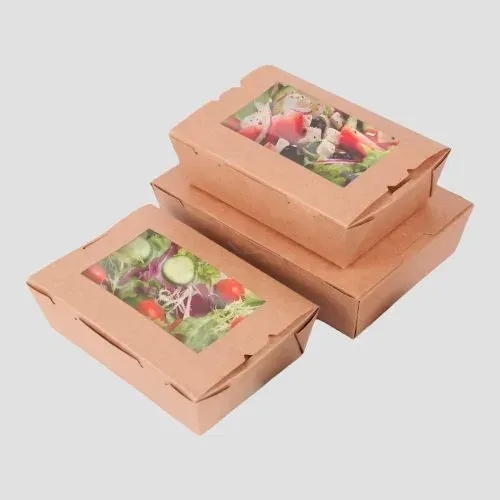
- PLA-lined kraft boxes: designed for industrial composting, not for the paper recycling bin.
- Cutlery and straws: wooden cutlery, bamboo and bagasse items avoid plastic, but compostable claims still need certification of the specific item.
In Canada, the Single-use Plastics Prohibition Regulations ban cutlery, stir sticks, straws and foodservice ware made from problematic plastics, including expanded polystyrene foam and black plastic made with carbon black. Fiber, wood, bamboo and bagasse alternatives are outside the ban.
What you can and cannot claim on event packaging
A caterer that prints or announces "compostable" takes on the claim. Under the FTC Green Guides, a compostable claim must be substantiated, and qualified when composting facilities are not available to a substantial majority of consumers where the item is sold or used. An unqualified "biodegradable" claim requires proof of complete decomposition within about one year after customary disposal, which landfills generally do not provide.
In California, AB 1201 requires products labeled "compostable" to meet ASTM-based testing (D6400 or D6868); the additional requirement to be an allowable input under the USDA National Organic Program has been delayed by CalRecycle to June 30, 2027. Practical wording for event signage: "Commercially compostable where facilities accept it. Please use the green bins." The full rules for labels are in our guide to recyclable vs compostable claims.
Five documents to request from your supplier
Direct Eco Green asks event and catering buyers to collect five documents before they commit to compostable packaging. A supplier that provides them without hesitation is usually a reliable one.
- The compostability certificate for the exact item: standard (ASTM D6400 or D6868, or CAN/BNQ 0017-088), certifier and certificate number.
- A PFAS declaration naming the grease barrier, with the lab report if one exists.
- A food-contact compliance letter that covers your real use: hot or cold food, fat content, holding time.
- The print proof showing the exact claim wording that will appear on the item.
- A written answer on end of life: where, realistically, this item gets composted in your market.
Tell Direct Eco Green which certification your market requires, and we confirm, before you order, which factory reference can document it. Bagasse plates, trays and bowls and kraft catering boxes start at 10,000 pieces, quotes come back within 48 hours, and samples are available before production. See our catering packaging range or send your event specifications.
Frequently asked questions
What does ASTM D6400 mean on catering packaging?
ASTM D6400 is the North American standard for plastics designed to compost in municipal or industrial composting facilities. Catering packaging tested to ASTM D6400, usually certified by BPI, has shown it breaks down under those conditions. It does not mean the item will compost in a backyard bin or in a landfill.
Is bagasse packaging automatically compostable?
No. Bagasse packaging is made from renewable sugarcane fiber and is commercially compostable where industrial composting facilities accept it, but a compostable claim requires certification of the specific item, typically to ASTM D6400 through BPI. Ask the supplier for the certificate number for the exact plate, tray or bowl.
Can caterers call their packaging biodegradable?
Caterers should avoid unqualified biodegradable claims. Under the FTC Green Guides, an unqualified biodegradable claim needs proof that the item fully decomposes within about one year after customary disposal, which landfills generally do not allow. A qualified compostable claim backed by certification is the safer wording.
When is reusable serveware better than compostable packaging for an event?
Reusable serveware is usually the better choice for seated events at venues with dishwashing, because it avoids single-use waste entirely. Compostable packaging is better suited to high-volume events without washing facilities, provided a composting outlet accepts the items and collection is organized.
Does Direct Eco Green sell BPI-certified compostable packaging?
Direct Eco Green manufactures bagasse, palm leaf, wooden and PLA-lined kraft packaging through partner factories, and certification depends on the specific factory reference. Tell Direct Eco Green which certification your market requires and it confirms, before you order, which factory reference can document it.