Key takeaways
- Ten US states ban intentionally added PFAS in food packaging, with effective dates from December 31, 2022 (New York) to December 31, 2024 (Hawaii).
- FDA's February 28, 2024 announcement describes a voluntary market phase-out of PFAS grease-proofing agents; federal authorizations do not override state bans.
- Canada published its final State of PFAS Report in March 2025 and proposed a phased approach in which food packaging falls in phase 2; no prohibition date has been set.
- PFAS also matter for claims: BPI compostable certification and California SB 343 recyclability criteria both exclude intentionally added PFAS.
- Direct Eco Green, a factory-direct manufacturer of eco-friendly packaging, builds grease resistance from molded fiber, PE or PLA films or aqueous coatings, and supplies the factory's PFAS declaration with your quote.
Why PFAS ended up in food packaging
PFAS (per- and polyfluoroalkyl substances) were used in paper and board food packaging because they repel both grease and water. That is what kept a pizza box from going soft, a fry bag from turning translucent and a molded-fiber plate from soaking up sauce.
The same carbon-fluorine chemistry that makes them effective also makes them extremely persistent, which is why they are often called "forever chemicals" and why legislators targeted food packaging first. Because PFAS did a real technical job, replacing them is a materials question, not just a paperwork exercise. The items most exposed are the ones that need a grease or moisture barrier on a fiber base.
| Packaging type | Why it needs a barrier | What to check |
|---|---|---|
| Pizza boxes, greaseproof trays | Hot, oily food in direct contact | Coating or treatment on the food-contact side |
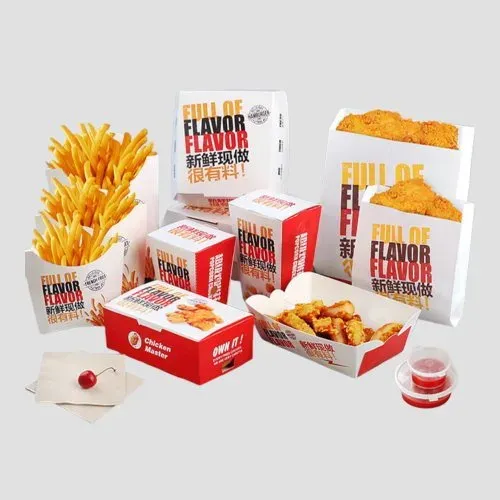
| Fry boxes, burger wraps, snack bags | Grease transfer through thin paper | Whether the paper is treated or film-lined |
| Molded fiber (bagasse) plates and bowls | Sauces and liquids | Additives used in the pulp |
| Coated paper cups and bowls | Liquid barrier | Type of coating (PE, PLA, aqueous) |
| Rigid plastic (PET, rPET, PP) | No fluorinated barrier needed | Lower priority for PFAS review |
Which US states ban PFAS in food packaging
Ten states currently ban intentionally added PFAS in food packaging. The dates below are when each ban took effect; Washington phased its restrictions in by product category.
| State | Ban on intentionally added PFAS in food packaging |
|---|---|
| New York | December 31, 2022 |
| California (AB 1200) | January 1, 2023 |
| Washington | Phased: February 1, 2023 and May 1, 2024 |
| Vermont | July 1, 2023 |
| Colorado | January 1, 2024 |
| Connecticut | January 1, 2024 |
| Maryland | January 1, 2024 |
| Minnesota | January 1, 2024 |
| Rhode Island | July 1, 2024 |
| Hawaii | December 31, 2024 |
Maine has food-packaging provisions scheduled for a later date; check the current status before shipping there. Product scope and definitions differ from state to state, so a national chain usually adopts the strictest common rule: no intentionally added PFAS in any food-contact packaging, everywhere it operates. That is simpler to manage than a state-by-state SKU list, and it avoids the risk of the wrong carton reaching the wrong distribution center.
What FDA has done at the federal level
There is no federal ban on PFAS in food packaging. On February 28, 2024, FDA announced that grease-proofing substances containing PFAS are no longer being sold for food-contact use in the US, as the result of a voluntary market phase-out by manufacturers.
Two consequences matter for buyers. First, the FDA announcement does not replace state law: federal food-contact authorizations do not override state bans, so a state's prohibition still applies on its own terms. Second, the phase-out concerns the US market. Imported packaging made overseas still needs to be checked at the item level, because the barrier chemistry depends on the factory and the paper mill, not on what is sold in the US.
Canada's plan for PFAS in food packaging
Canada has not yet banned PFAS in food packaging, but it has started the process. On March 5, 2025, Environment and Climate Change Canada and Health Canada published the final State of PFAS Report, which concludes that the class of PFAS, excluding fluoropolymers, is harmful.
On March 8, 2025, the government proposed an order to add PFAS (excluding fluoropolymers) to Schedule 1 of the Canadian Environmental Protection Act and outlined a phased risk-management approach:
- Phase 1: firefighting foams.
- Phase 2: non-essential consumer uses, including food packaging materials, cosmetics and textiles.
- Phase 3: uses that need further evaluation.
No food-packaging prohibition date has been set. For brands selling in both countries, the sensible move is to apply the same PFAS-free specification to Canadian orders now, rather than requalifying packaging later.
Where PFAS rules meet compostable and recyclable claims
PFAS limits also apply indirectly through labels. Two rules matter most.
- BPI compostable certification: since January 1, 2020, BPI prohibits intentionally added fluorinated chemicals. Certified products need a test from a BPI-approved lab showing total organic fluorine at or below 100 ppm, plus a statement of no intentional addition.
- California SB 343: the state's recyclability criteria, which govern the chasing-arrows symbol and "recyclable" claims from October 4, 2026, include no intentionally added PFAS and PFAS below 100 ppm.
So a packaging item with a fluorinated barrier cannot carry a credible compostable claim, and cannot carry a recyclable claim in California. How to word those claims is covered in our guide to recyclable vs compostable claims.
PFAS-free grease barriers that work
Direct Eco Green, a factory-direct manufacturer of eco-friendly packaging, gets grease and moisture resistance from molded fiber density, PE or PLA films, or aqueous coatings rather than fluorinated treatments. Clay coatings are another PFAS-free option on the market. These solutions are mature; the choice is a trade-off between barrier performance and end of life.
| Barrier | How it works | Example formats | End-of-life note |
|---|---|---|---|
| Molded fiber density | Tightly pressed sugarcane fiber resists grease | Bagasse bowls and boxes, plates, trays | Commercially compostable where facilities accept it |
| PLA film lining | Thin bio-based film on kraft paper | Fry boxes, wraps, salad boxes | Not curbside recyclable in most US programs |
| PE film coating | Plastic film on paperboard | Paper cups, soup bowls | Accepted in some recycling programs; check locally |
| Aqueous dispersion coating | Water-based barrier, no film | GreenCup paper cups | Designed for paper recycling streams |
| Clay coating | Mineral coating on paper | Wraps and liners on the wider market | Depends on local paper programs |
Test any replacement under real conditions. A container that holds a cold salad perfectly may behave differently with a hot, oily dish kept warm for two hours.
How to document PFAS-free packaging with your supplier
Direct Eco Green recommends a four-step PFAS file for every food-contact item you buy, because a "PFAS-free" line in a catalog is not evidence.
- Map your at-risk items. Start with paper, board and molded fiber that resists grease or moisture. Rigid plastics without a fiber base come second.
- Get a written declaration per item. It should state that no PFAS are intentionally added and name the barrier used (PLA film, PE film, aqueous coating or the molded fiber itself). A catalog-wide statement is too vague; tie it to the item and the production site.
- Test the sensitive items. Total organic fluorine screening is the method BPI relies on for its 100 ppm threshold; ask for the lab name and date on any report.
- Lock it into the contract. Require the supplier to notify you before changing a coating, paper grade or factory.
With Direct Eco Green, the grease barrier comes from PLA film, PE film, an aqueous coating or the molded fiber itself, not from fluorinated treatments. Ask for the factory's PFAS declaration with your quote, which comes back within 48 hours, and request samples before production. Browse our plastic-free food packaging or send your specifications.
Frequently asked questions
Which US states ban PFAS in food packaging?
New York, California, Washington, Vermont, Colorado, Connecticut, Maryland, Minnesota, Rhode Island and Hawaii ban intentionally added PFAS in food packaging, with effective dates between December 31, 2022 and December 31, 2024. Maine has food-packaging provisions scheduled for a later date. Scope and definitions vary by state, so check each law for the products you sell.
Is there a federal PFAS ban on food packaging in the US?
No. On February 28, 2024, FDA announced that PFAS grease-proofing substances are no longer being sold for food-contact use in the US through a voluntary market phase-out. That announcement does not override state bans, which continue to apply on their own terms.
Does Canada ban PFAS in food packaging?
Not yet. Canada published its final State of PFAS Report on March 5, 2025 and proposed adding PFAS, excluding fluoropolymers, to Schedule 1 of CEPA, with food packaging materials in phase 2 of a phased approach. No prohibition date for food packaging has been set.
Is compostable packaging automatically PFAS-free?
Not automatically, because compostability describes end of life, not barrier chemistry. BPI-certified compostable products are a strong signal, since BPI has prohibited intentionally added fluorinated chemicals since 2020 and requires total organic fluorine at or below 100 ppm. For uncertified compostable packaging, ask for a per-item PFAS declaration.
How does Direct Eco Green make food packaging grease-resistant without PFAS?
Direct Eco Green uses the density of molded sugarcane fiber, PLA or PE film linings, or aqueous dispersion coatings to resist grease, not fluorinated treatments. Buyers can request the factory's PFAS declaration with their quote and test samples before production.
Sources
- PFAS in Food Packaging: State Compliance Guide (Olsson Frank Weeda)
- FDA Announces PFAS Used in Grease-Proofing Agents for Food Packaging No Longer Being Sold in the U.S.
- BPI: Fluorinated Chemicals Policy
- Canada Releases Final State of PFAS Report and Proposed Risk Management Approach (Bergeson & Campbell)