Key takeaways
- MOQs come from fixed costs per run: tooling, printing plates, machine setup and minimum paper or material purchases.
- Above the MOQ, unit price falls because those fixed costs are spread over more pieces; below it, the factory cannot run efficiently.
- The cheapest levers are design choices: existing molds and sizes, fewer colors, shared materials and shared print plates.
- Overbuying has real costs: storage, cash tied up, and stock that may no longer match state PFAS laws or claim rules such as California SB 343.
- Direct Eco Green's MOQs range from 1,000 pieces (cake, donut and candy boxes) to 50,000 pieces (GreenCup), and every quote within 48 hours states the MOQ per item.
What a packaging MOQ is and why factories set one
An MOQ is the smallest quantity a factory will produce for one reference in one run. It is set at the level where the fixed cost of preparing the run is low enough per piece for the product to be sold at a sensible price.
A packaging run is not like picking stock from a shelf. Before the first good piece comes off the line, the factory has to prepare tools, print plates, materials and machines. That preparation costs roughly the same whether the run is short or long. Spread over a small run, it makes each piece expensive; spread over a large run, it almost disappears.
This is why a distributor selling stock items can ship a single case, while a manufacturer producing custom printed or private label packaging sets a minimum. Neither is wrong. They are different business models, and the right one depends on your volume.
The four fixed costs behind every MOQ
Four fixed costs explain most packaging MOQs: tooling, printing plates, machine setup and minimum material purchases. The table shows why each one is fixed and how you can reduce it.
| Fixed cost | Why it does not depend on quantity | How to reduce it |
|---|---|---|
| Tooling (molds, cutting dies) | A molded bagasse plate needs a mold; a folding box needs a cutting die for its shape | Use an existing size or shape; a custom size requires a new mold |
| Printing plates and color setup | Each print color typically needs its own plate or setup, and colors must be matched before the run | Fewer colors; the same artwork across sizes; unprinted for some items |
| Machine setup and start-up waste | Adjusting the line, registering the print and running test pieces takes time and material | Fewer references, longer runs per reference |
| Paper rolls and raw materials | Board, kraft paper and fabric are bought in rolls or lots; a special grade or color means buying a full lot | Choose standard grades; use one board across several formats |
Not every product has all four. A plain kraft bag uses no mold; a bagasse bowl usually has no print. That is one reason MOQs vary so much between product families.
Direct Eco Green MOQs by product family
Direct Eco Green manufactures through audited partner factories and publishes its known MOQs by product family; for other items the MOQ depends on material, size and printing and is stated in your quote.
| Product family | MOQ | Main fixed cost behind it |
|---|---|---|
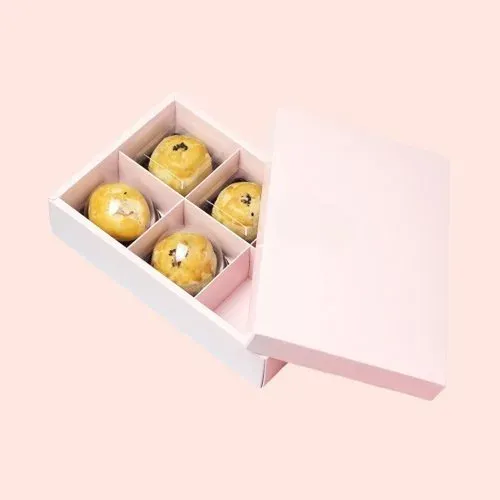
| Cake, donut and candy boxes | 1,000 pcs | Cutting die and print setup |
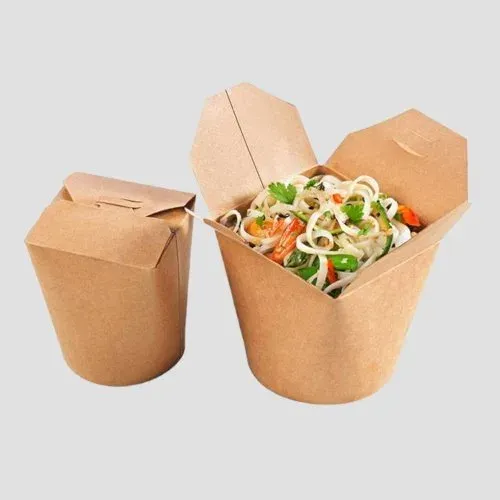
| Pasta and noodle boxes | 5,000 pcs | Cutting die, print setup, board |
| Bagasse plates, trays and bowls | 10,000 pcs | Molds and molding line setup |
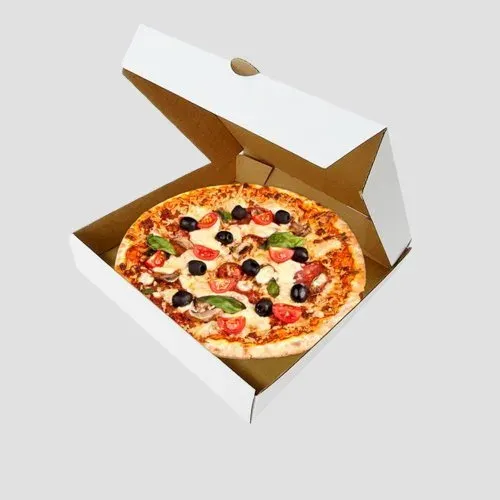
| Salad and catering boxes, pizza boxes | 10,000 pcs | Cutting dies, print, board |
| Paper cups, paper bowls, wooden boxes | 10,000 pcs | Forming line setup, print |
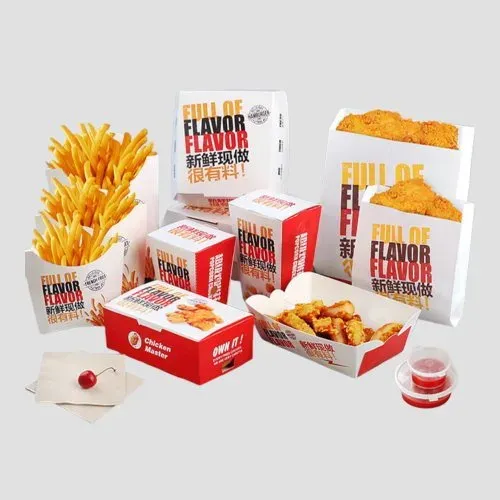
| Fry, wrap and kebab packaging | 20,000 pcs | High-speed line setup, paper rolls |
| GreenCup plastic-free cups | 50,000 pcs | Coated paperboard and cup-forming setup |
The "main fixed cost" column is a general explanation of what drives minimums for that type of product, not a breakdown of a specific quote. MOQs apply per reference (per size) unless your quote says otherwise.
How to lower your unit cost without overbuying
The most effective way to lower unit cost is to make your order easier to produce, not bigger: share tools, plates and materials across references and consolidate shipments.
- Start from existing sizes. A standard mold or die avoids tooling. Check the factory's format list in the product page before designing a new shape.
- Reduce print colors. One or two colors on kraft often look deliberate and cost less to set up than full color.
- Use one artwork across sizes. The same logo and layout on a small, medium and large box simplifies setup and approval.
- Standardize the material. One board grade or one fabric weight across formats lets the factory buy and run material efficiently.
- Cut the number of SKUs. Three well-chosen sizes at a higher volume each usually cost less per piece than six sizes at the minimum.
- Consolidate shipments. Grouping several items in one consolidated shipment lowers freight per piece; a partner that combines several factories into one order helps here.
- Ask about scheduling. Ask your supplier whether an annual volume can be produced or shipped in stages; the answer depends on the product and is set in the quote.
Compare quotes on total landed cost, including freight and duties, not on unit price alone. Our guide to sourcing beyond China covers the tariff side.
The hidden cost of buying far above the MOQ
Ordering far more than you need lowers the unit price on paper but adds costs that rarely show up in the quote: storage, cash tied up in stock, damage, and packaging that becomes obsolete before it is used.
- Storage and handling. Bulky items such as pizza boxes and bowls take warehouse space for months.
- Cash flow. Money spent on a year of packaging is not available for the business.
- Regulatory change. Printed claims and materials can go out of date. State PFAS laws now ban intentionally added PFAS in food packaging in several states, and from October 4, 2026, California SB 343 restricts the chasing-arrows symbol and "recyclable" claims to materials that meet state criteria. Stock printed with a claim you can no longer use is lost money.
- Brand change. A new logo or menu makes printed stock obsolete.
A practical rule: buy the quantity you will use within a period you can store and forecast confidently, and check every printed claim against the FTC Green Guides before the run. See recyclable vs compostable claims.
Why factory-direct sourcing changes the MOQ equation
Direct Eco Green is a factory-direct manufacturer and sourcing partner, not a distributor, so buyers pay for production runs rather than for stock held in a warehouse. For high-volume orders this lowers total cost of ownership; for small, urgent needs of stock items, a catalog distributor is often the better choice.
- Custom printing and private label on most families, with custom sizes where a mold or die can be made.
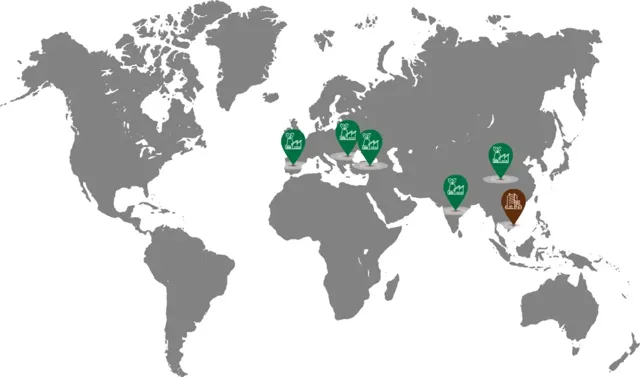
- Multi-factory consolidation across partner factories in Vietnam, China, India, Turkey, Bulgaria and Spain.
- Samples before production and on-site quality control in Vietnam.
- A tailored quote within 48 hours stating the MOQ for each reference.
Send your list of items, sizes and yearly volumes through the contact form, or start from the catalog.
Frequently asked questions
What does MOQ mean in packaging?
MOQ means minimum order quantity: the smallest number of pieces a factory will produce for one packaging reference in one run. The MOQ covers fixed costs such as molds, cutting dies, printing plates, machine setup and material bought by the roll or lot.
Why are MOQs higher for custom printed packaging?
Custom printed packaging needs printing plates, color matching and print setup for each design, and those costs are the same for a short run as for a long one. Spreading them over more pieces keeps the unit price reasonable, which is why custom printed packaging usually has a higher MOQ than unprinted stock.
What is the minimum order for Direct Eco Green packaging?
Direct Eco Green MOQs depend on the product family: 1,000 pieces for cake, donut and candy boxes, 5,000 for pasta boxes, 10,000 for bagasse tableware, salad, pizza, paper cup, paper bowl and wooden boxes, 20,000 for fry and wrap packaging and 50,000 for GreenCup. For other items the MOQ depends on material, size and printing and is stated in the quote.
Can I order less than the MOQ?
Ordering less than the MOQ is sometimes possible for a standard, unprinted item, usually at a higher unit price, but it depends on the factory and the product. Ask the question when you request your quote. For very small quantities of stock items, a catalog distributor may be the better option.
How can I reduce the unit cost of eco-friendly packaging?
To reduce the unit cost of eco-friendly packaging, use existing sizes and molds, reduce print colors, use one artwork and one material across formats, cut the number of SKUs and consolidate shipments. Compare offers on total landed cost, including freight and duties, rather than on unit price alone.