Key takeaways
- Landed cost = product + origin charges + freight + insurance + duties + entry fees + broker and filing costs + inland delivery.
- Since July 24, 2026, Section 301 forced-labor tariffs of 10% or 12.5% apply to imports from 60 economies; a Court of International Trade case was argued on September 30, 2026 and had not been decided as of mid-October.
- US entry fees in FY2027 (from October 1, 2026): MPF 0.3464% of value (minimum $34.58, maximum $670.86 per formal entry) and HMF 0.125% on ocean cargo.
- Direct Eco Green consolidates products from several partner factories into one shipment, so one set of entry fees and one broker charge covers the whole order.
The landed cost formula
Comparing suppliers on unit price alone is the most common sourcing mistake in packaging. Paper and molded-fiber items are bulky and light, so freight and fixed import costs weigh far more on them than on dense goods. Build every comparison on the full formula:
Landed cost = product price + origin charges + international freight + insurance + duties and tariffs + entry fees + broker, filing and bond costs + inland delivery
Then divide by the number of usable units received. Add a line for inventory carrying cost (storage and cash tied up) if you buy several months of stock at once, a point our guide to packaging MOQs covers in detail.
Incoterms: who pays which line
The Incoterm in your quote decides which of those lines are already included. The four you will meet most often for packaging:
| Incoterm | Seller pays up to | You still pay | When it suits |
|---|---|---|---|
| EXW (Ex Works) | Goods ready at the factory | Everything from the factory gate, including export clearance | Rarely: you need your own agent at origin |
| FOB (Free On Board) | Goods loaded on the vessel at the origin port | Ocean freight, insurance, import duties and fees, delivery | Importers with their own freight forwarder |
| CIF (Cost, Insurance and Freight) | Freight and minimum insurance to the destination port | Destination charges, duties, fees, delivery | Buyers who want one price to the port |
| DDP (Delivered Duty Paid) | Delivery to your door, duties paid | Unloading | Simplest budgeting; check who is importer of record |
For US customs purposes, duty is generally calculated on the transaction value excluding international freight and insurance, which is why FOB values are the usual starting point. Canada likewise values goods at the point of direct shipment to Canada.
US tariffs on imported packaging as of October 2026
The US tariff picture changed three times in 2026. On February 20, the Supreme Court invalidated the tariffs imposed under IEEPA; a temporary 10% surcharge under Section 122 of the Trade Act of 1974 replaced them from February 24 until it expired on July 24. Since July 24, 2026, USTR's Section 301 forced-labor action applies tariffs of 10% or 12.5% to imports from 60 economies covering about 99.4% of US imports, depending on whether each country committed to ban imports made with forced labor. Goods from China remain subject to their older Section 301 duties on top.
These tariffs come in addition to the ordinary duty for the product's HTS classification, which is often low or zero for packaging: corrugated boxes under HTS 4819.10, for example, carry a general rate of zero, while many plastic tableware items under 3924.10 carry 3.4%. Classification is item by item, so ask your broker to confirm the HTS code before you order.
Two open risks remain. The forced-labor tariffs are being challenged at the Court of International Trade (oral argument on September 30, 2026; no ruling as of mid-October), and USTR opened a separate Section 301 investigation into Vietnam on May 29, 2026. Low-value shipments no longer enter duty-free either: the $800 de minimis exemption has been suspended for all countries, most recently by an order effective February 24, 2026. Treat every figure here as a snapshot and confirm with a licensed customs broker before you place an order. Our guide to sourcing packaging beyond China compares the main production countries.
US entry fees and filing costs
| Cost line | How it is calculated | Notes |
|---|---|---|
| Merchandise Processing Fee (MPF) | 0.3464% of entered value | FY2027 (from Oct. 1, 2026): minimum $34.58, maximum $670.86 per formal entry |
| Harbor Maintenance Fee (HMF) | 0.125% of cargo value | Ocean shipments only; no cap |
| Importer Security Filing (ISF) | Broker or forwarder service charge | Required for ocean cargo at least 24 hours before loading at origin |
| Customs bond | Single-entry or continuous (annual) bond | Continuous bonds must cover at least 10% of the prior 12 months' duties, taxes and fees, with a $50,000 minimum |
| Customs broker | Per-entry fee | Plus classification work for new items |
Because MPF has a cap and broker, ISF and bond costs are charged per entry, they fall sharply per unit when you ship more product under one entry. That is where consolidation pays.
A worked example
The figures below are illustrative round numbers chosen to show the arithmetic, not market prices or a Direct Eco Green quote. Assume an ocean shipment of corrugated boxes with an FOB value of $20,000, a country in the 12.5% Section 301 group and a zero ordinary duty rate.
| Line | Amount |
|---|---|
| Product, FOB | $20,000 |
| Ocean freight and destination port charges (assumed) | $3,000 |
| Cargo insurance (assumed) | $60 |
| Ordinary duty (HTS 4819.10, general rate free) | $0 |
| Section 301 forced-labor tariff, 12.5% of $20,000 | $2,500 |
| MPF, 0.3464% of $20,000 | $69.28 |
| HMF, 0.125% of $20,000 | $25 |
| Broker, ISF and single-entry bond (assumed) | $400 |
| Inland delivery to the warehouse (assumed) | $600 |
| Landed cost | $26,654.28 |
In this scenario the landed cost is about 33% above the FOB price, and the tariff alone is the largest single addition. Replace each assumption with your own freight quote and broker rates; the structure stays the same.
Importing into Canada
Canada applies its own Customs Tariff, not US tariffs. Goods pay the most-favoured-nation (MFN) rate unless they qualify for a preferential rate under a trade agreement; Vietnam, for example, is a member of the CPTPP along with Canada, so eligible goods with proper proof of origin can enter at preferential rates. GST is charged on the duty-paid value at import, and commercial importers must be registered in the CBSA's CARM portal. North American goods may qualify under CUSMA. Rates and eligibility depend on the exact tariff item, so confirm with a Canadian customs broker.
How to lower landed cost without lowering quality
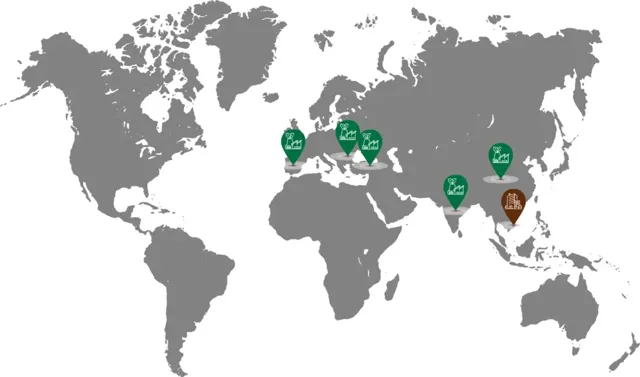
- Consolidate. Ship cups, bowls, boxes and bags from several factories in one container under one entry. Direct Eco Green consolidates orders across its partner factories in Vietnam, China, India, Turkey, Bulgaria and Spain for exactly this reason.
- Fill the container. Nested and flat-packed items (unassembled boxes, stacked bowls) ship far more units per cubic meter.
- Order at the MOQ rhythm that fits your storage, not the largest quantity offered; carrying cost is real.
- Classify correctly. A wrong HTS code can mean overpaying for years or penalties later.
- Compare countries on landed cost, using the same freight and fee assumptions for each quote.
Send your item list, quantities and delivery city through the quote form: Direct Eco Green replies within 48 hours with a factory-direct quote and can propose a consolidated shipment plan. Browse the full catalog or our wholesale food packaging page to build your list.
Frequently asked questions
What is included in the landed cost of imported packaging?
Landed cost includes the product price, origin charges, international freight, insurance, customs duties and tariffs, entry fees such as the US Merchandise Processing Fee and Harbor Maintenance Fee, broker, filing and bond costs, and delivery to your warehouse. Divide the total by the usable units received to get a landed cost per unit.
What tariffs apply to packaging imported into the US in 2026?
As of October 2026, imports pay the ordinary duty for their HTS code (zero for corrugated boxes under 4819.10, 3.4% for many plastic tableware items under 3924.10) plus the Section 301 forced-labor tariff of 10% or 12.5% that applies to 60 economies since July 24, 2026. Goods from China also pay older Section 301 duties. Confirm with a licensed customs broker, as litigation is ongoing.
How much is the Merchandise Processing Fee in 2026?
The MPF is 0.3464% of the entered value of a formal entry. For fiscal year 2027, which started on October 1, 2026, the minimum is $34.58 and the maximum is $670.86 per entry. The Harbor Maintenance Fee adds 0.125% of cargo value on ocean shipments.
Is the $800 de minimis exemption still available for packaging imports?
No. Duty-free de minimis treatment for low-value shipments has been suspended for all countries since August 29, 2025, and an order effective February 24, 2026 continued the suspension after the Supreme Court's IEEPA ruling. Small shipments must be entered and pay applicable duties.
How does consolidation reduce landed cost?
Broker fees, filing charges and bonds are charged per entry, and the MPF is capped per formal entry, so combining products from several factories into one shipment spreads those fixed costs over more units. Direct Eco Green consolidates multi-factory orders for US and Canadian buyers for this reason.
Sources
- USTR fact sheet: Section 301 action on 60 economies (July 2026)
- Olshan Frome Wolosky: Supreme Court invalidates IEEPA tariffs; Section 122 surcharge
- Sandler, Travis & Rosenberg: De minimis suspension remains in place
- Ginger Control: Customs fees explained (MPF, HMF, ISF, bonds)
- Seko Logistics: Section 301 developments, forced labor and Vietnam